Research · Bioastronautics
Spatial Disorientation Countermeasures for Lunar Landing
A system that estimates, in real time, how disoriented a pilot is, and puts a flight display in front of them at the moment they need it. In laboratory testing it eliminated boundary violations entirely. Bioastronautics group, CU Boulder, under Dr. Torin Clark.
NASA Human Research Program · abstract submitted, paper in preparation
The problem with telling a disoriented pilot to check the instruments
Spatial disorientation is a leading cause of aviation mishaps. The brain estimates which way is up by fusing vestibular, visual and somatosensory cues, and a lunar landing attacks that estimate from two directions at once: the crew has just come through a gravity transition, and there are almost no visual cues outside to correct against. Tilt and translation get misperceived, and the pilot flies the misperception.
The obvious objection is that pilots already have instruments telling them their true attitude. The reason that does not solve the problem is the whole motivation for this work: a disoriented pilot does not know they are disoriented. Their internal sense of orientation feels correct, so there is no moment at which they think to cross-check the display. Availability was never the constraint. Knowing when to look is.
So the countermeasure cannot wait to be consulted. It has to detect the disorientation itself and interrupt.
Estimating disorientation in real time
Disorientation is a difference between what a pilot perceives and what is actually happening, and the perceived half is not directly measurable. The approach is to model it. An Observer model of spatial orientation perception takes the vehicle’s actual motion as input and predicts what the pilot perceives, unobtrusively and while the task is running.
Comparing that prediction against the true vehicle state collapses to a single scalar, a spatial disorientation metric on a scale of 0 to 10, that answers “how disoriented is this pilot, right now”. When the metric crosses a threshold, the flight display is triggered.
| 1 · Pilot | Flies a nulling task on the Tilt Translation Sled, in the dark. |
|---|---|
| 2 · Observer model | Predicts the pilot’s perceived orientation in real time from the actual motion. |
| 3 · SD metric | Perceived state against true state, reduced to one number from 0 to 10. |
| 4 · Trigger | The flight display appears when that number crosses threshold. |
The experiment, and the control that makes it mean something
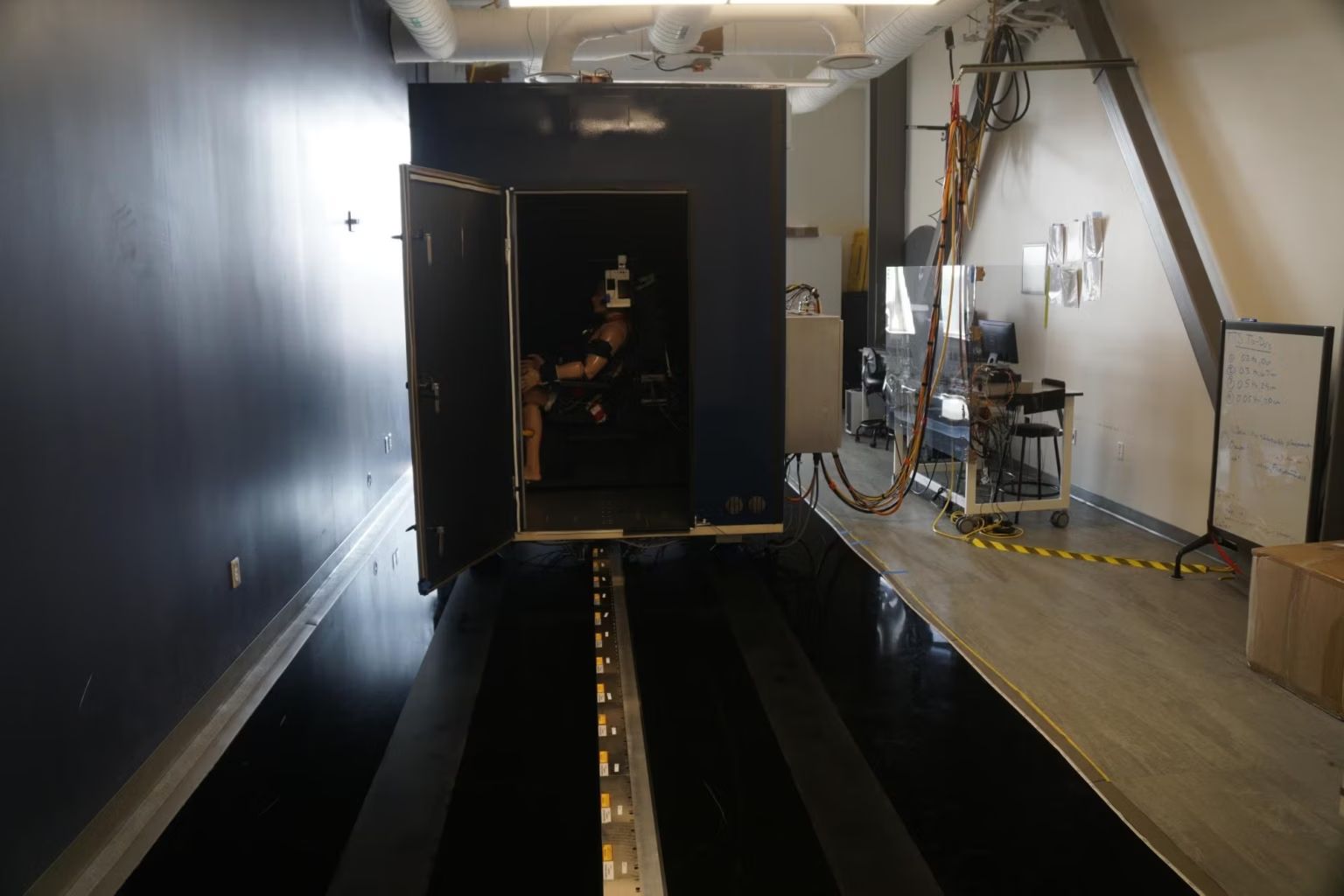
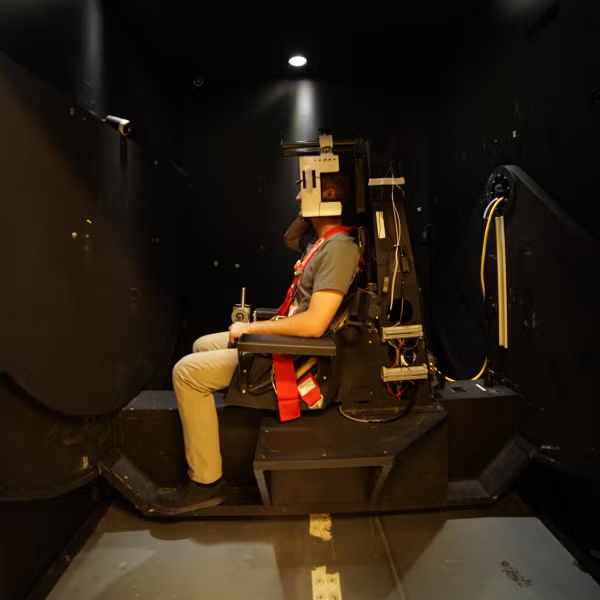
Subjects sat on the Tilt Translation Sled, a two-degree-of-freedom motion device combining roll-tilt with lateral translation, in darkness with the head restrained so that non-vestibular cues were suppressed. Each trial opened with a small translational disturbance that pushed the device off-centre; the pilot’s job was to return to centre with a joystick and hold it there. A trial ended either at the end of the piloting period or early, by exceeding a translational boundary limit. Running simultaneously was a non-piloting visual search task on a heads-up display, present to force a realistic division of attention, and deliberately unavailable while the pilot’s instruments were being viewed.
The design was within-subjects across two counterbalanced blocks, 15 subjects, 15 trials each. In one block the display was triggered by the SD metric. In the other, the control, triggers were matched in frequency but placed at random times.
That control is the part worth dwelling on. A study comparing “display” against “no display” could only ever conclude that showing a pilot their attitude helps, which nobody doubts. By holding total screen time fixed and varying only when it appears, the experiment isolates the actual claim under test: that a model can identify the moments that matter. Any benefit that survives this comparison is attributable to the timing, not to the display.
Results
Zero. The translational boundary limit was never exceeded in the countermeasure block, across every subject and every trial. In the random control, nearly every participant exceeded it at least once. The difference is statistically significant on a Wilcoxon signed-rank test.
The secondary task was the obvious place for the benefit to be paid for. It was not: a paired comparison of non-piloting task score found no significant difference between the countermeasure and control blocks. The system bought a large safety improvement without the attentional penalty that would normally be the price.
A per-subject exposure analysis pushes the interpretation further. Subjects varied in how often the display actually fired, which allows the question of whether more triggering produces better outcomes rather than merely different ones. It does: subjects who received more SD-driven triggers showed both lower piloting RMS error and fewer boundary violations, with a modest cost to the secondary-task score. That last one is the honest trade-off, and it points the same way as everything else, since attention moved to the display when the model said it should.
What this does not show
The conditions that make the result clean also make it narrow. Subjects were in darkness with the head restrained, which strips out non-vestibular cues a real cockpit would provide. The sled offers two degrees of freedom, not the six of an actual flight. The task is a one-dimensional nulling problem rather than a navigation and landing profile. And the SD metric is currently tuned for Earth gravity, not for the post-transition lunar case the mission actually involves.
Those four items are also the roadmap: realistic navigation and landing tasks with operational displays, a six-degree-of-freedom motion platform, a third triggering mode keyed to vehicle orientation to complement the perceptual metric, and re-tuning the metric for lunar and Martian gravity after a transition.
My role
This is an ongoing project in Dr. Torin Clark’s Bioastronautics group, not my own line of research, and it long predates my joining it. I am an undergraduate contributor: I ran subject testing, instrumented participants with wearable ECG and EMG electrode systems and data acquisition hardware, and did some of the data analysis, including the exposure-response results above, which I presented through CU’s SPUR program.
Alongside the disorientation study I work on hardware for the group: contributing to the mechanical design of a human-rated centrifuge for altered-gravity testing, and designing and 3D-printing custom laboratory equipment, including a parametric hinged enclosure that houses a wearable physiological DAQ and clamps its electrode connector so the connection survives a subject run.
Being a junior author on a project already in motion has been the most useful thing about it. The experimental design decisions that make these results defensible, particularly matching trigger frequency in the control rather than comparing against no display at all, were made before I arrived, and seeing why they were made is not something you get from reading a finished paper.
Publication
Laboratory Assessment of a Spatial Disorientation Triggering System to Aid Pilots. P. Gupta, T. L. Lonner, A. R. Nipunge, A. Valente and T. K. Clark. Smead Aerospace Engineering Sciences, University of Colorado Boulder. Abstract submitted; full paper in preparation.
This material is based upon work supported by the National Aeronautics and Space Administration under Grant No. 80NSSC23K0449, with SPUR supported by the Engineering Excellence Fund.